This guide cuts through the marketing hype to give you the facts. We'll break down what plant-based burgers are made of, how they differ from traditional veggie burgers, whether they're truly healthier than beef, and what vegans need to know before purchasing. Whether you're reducing meat for health, ethical, or environmental reasons—or simply curious—you'll learn how to choose the right product for your goals.
TLDR: Key Takeaways
- Plant-based burgers use isolated proteins (pea, soy, legume) and engineered fats to mimic beef, but nutritional quality varies widely between brands
- "Veggie burger" and "plant-based burger" are not interchangeable — one is minimally processed whole food, the other is highly engineered
- Plant-based doesn't mean healthy—many contain 370mg+ sodium per patty versus 75mg in plain beef
- Not all are vegan-friendly; some use egg or dairy binders, or involve animal testing in production
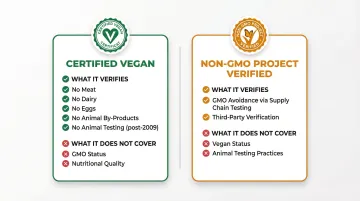
- Look for Certified Vegan and Non-GMO logos to ensure products align with your values
What Are Plant-Based Burgers Made Of?
Plant-based burgers are engineered patties designed to replicate the taste, texture, appearance, and even the "bleed" of beef using entirely plant-derived ingredients. Unlike traditional veggie burgers that celebrate vegetables and grains, these products are food science achievements — biomimicry projects engineered to fool your senses into thinking you're eating meat.
Protein Bases
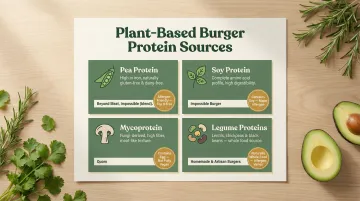
The foundation of any plant-based burger is its protein source, and the two most common are pea protein and soy protein.
Pea protein (used by Beyond Meat) is extracted from yellow split peas and sits outside the FDA's nine major food allergens — a meaningful advantage for people with common food sensitivities.
Soy protein (used by Impossible Foods) is derived from soybeans and is recognized by the FDA as a major allergen requiring explicit labeling. For consumers with soy allergies, pea-based options are the safer call.
Other brands reach further down the ingredient list:
- Mycoprotein (fungi-derived protein)
- Lentils, black beans, or chickpeas as whole-food protein bases
- Rice protein blended with other sources
Each protein base delivers a different texture and nutritional profile, so checking labels matters.
Fats and Binders
To replicate the juicy mouthfeel of beef, manufacturers add plant-based fats — primarily coconut oil, which contains 11.2g of saturated fat per tablespoon. Its high saturation keeps it solid at room temperature, closely mimicking beef fat.
Impossible Foods uses a blend of coconut and sunflower oils. Beyond Meat recently reformulated to avocado oil, cutting saturated fat to just 2g per patty.
Holding these proteins and fats together requires specialized binders:
- Methylcellulose forms a firm gel when heated, reducing cooking loss and improving texture (it's a synthetic cellulose polymer)
- Tapioca and potato starches — thickeners that add cohesion
- Oats or breadcrumbs — dry ingredients that absorb moisture and add structure
Flavor Enhancers
The ingredient most responsible for that meaty, savory flavor is heme iron.
Impossible Foods uses soy leghemoglobin, a protein containing heme that replicates the metallic, savory flavor and red "bleed" of beef. Because extracting this from soy roots isn't commercially viable, Impossible produces it via fermented genetically engineered yeast (Pichia pastoris). In 2018, the FDA issued a "no questions" letter regarding its safety, granting it Generally Recognized as Safe (GRAS) status.
However, this ingredient raises concerns for strict vegans: Impossible Foods conducted 14- and 28-day rat toxicity studies to secure FDA approval, violating the ethical standards of organizations like Vegan Action, which prohibit animal testing after 2009.
Heme aside, manufacturers round out the flavor profile with:
- Nutritional yeast for umami depth
- Natural flavors (a broad category that may include dozens of compounds)
- Sodium — often in high quantities, with some brands exceeding 370mg per patty compared to just 75mg in plain ground beef
Veggie Burger vs. Plant-Based Burger: What's the Difference?
Most people use these terms interchangeably — but they describe two very different products, and the gap matters when you're reading a nutrition label.
Veggie Burgers: Whole-Food Simplicity
A veggie burger is any meatless patty made from vegetables, grains, legumes, nuts, or mushrooms. These have never tried to mimic meat — they're satisfying on their own terms.
A classic lentil and brown rice patty, for example, might list just 8-10 recognizable ingredients: lentils, water, salt, olive oil, onion, carrot, black pepper, soy sauce, oats, and breadcrumbs.
Veggie burgers are typically minimally processed, retaining the fiber, vitamins, and minerals of their whole-food ingredients.
Plant-Based Burgers: Engineered Meat Mimics
A plant-based burger is a newer, more specific category of products engineered to imitate beef's flavor, texture, appearance, and even "bleed." These are heavily processed foods, often containing 15-20+ ingredients including isolated proteins, synthetic binders, and engineered flavor molecules.
The USDA Agricultural Research Service notes that while consumers often believe plant-based foods are minimally processed, modern plant-based meats are actually "ultra-processed and contain numerous food-grade chemicals as ingredients."
Key differences:
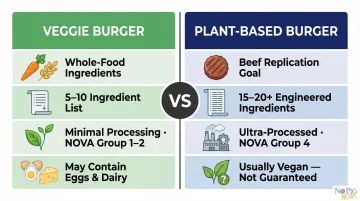
| Aspect | Veggie Burger | Plant-Based Burger |
|---|---|---|
| Goal | Satisfying vegetarian option | Beef replication |
| Ingredients | 5-10 whole foods | 15-20+ isolated/engineered ingredients |
| Processing | Minimal (NOVA Group 1-2) | Ultra-processed (NOVA Group 4) |
| Vegan status | Not guaranteed (may contain eggs/cheese) | Usually vegan, but not always |
Always check the label. Eggs and cheese show up in some veggie burgers; dairy-derived binders appear in certain plant-based options. "Veggie" and "plant-based" are marketing categories, not ingredient guarantees.
Are Plant-Based Burgers Healthy?
Let's be clear: "plant-based" is not a synonym for "healthy." A potato chip is plant-based. So is a heavily processed, sodium-laden patty. The question isn't whether something is plant-based—it's whether it supports your nutritional goals.
Potential Benefits
Plant-based burgers offer several advantages over beef:
- Zero cholesterol — beef contains 80mg per 4oz serving; plant-based options have none
- Lower saturated fat (brand-dependent) — Beyond's avocado oil formula has just 2g vs. beef's 8.6g
- Dietary fiber — plant-based burgers provide 2-5g per serving; beef has zero
- Reduced cancer risk — The WHO's International Agency for Research on Cancer classified red meat as "probably carcinogenic" (Group 2A) based on links to colorectal cancer. Substituting red meat eliminates this specific risk
For people reducing red meat intake for health reasons, plant-based burgers can serve as a practical bridge food.
Concerns and Limitations
The processing itself is a problem. Harvard T.H. Chan School of Public Health cautions that plant-based burgers rely on purified plant proteins rather than whole foods, stripping away many intrinsic nutrients. The body processes these isolated proteins more quickly, potentially affecting blood sugar and satiety.
Sodium is the biggest red flag. Compare these numbers per 4oz serving:
- Raw 80/20 ground beef: 75mg sodium
- Beyond Burger: 310mg sodium
- Impossible Burger: 370mg sodium
That's 5x more sodium in plant-based options. With the FDA recommending adults limit sodium to 2,300mg daily (ideally 1,500mg for heart health), one plant-based burger consumes 13-16% of your daily limit before you add condiments, cheese, or fries.
Less processed options beat meat analogues. The American Institute for Cancer Research advises that while replacing red meat with beans, vegetables, and whole grains reduces cancer risk, research hasn't confirmed whether highly processed meat analogues offer the same benefit.
Dietitians recommend tofu, tempeh, lentils, and beans instead—foods that retain natural fiber, healthy fats, and micronutrients without added sodium and synthetic binders.
Plant-Based Burgers vs. Beef Burgers: A Comparison
The right burger depends on what you're optimizing for. On some metrics, plant-based wins clearly; on others, beef holds its own. Here's how they actually compare.
Nutritional Trade-Offs
| Metric (per 4oz serving) | Beyond Burger | Impossible Burger | 80/20 Beef |
|---|---|---|---|
| Calories | 230 | 230 | 287 |
| Protein | 21g | 19g | 19.4g |
| Total Fat | 14g | 13g | 22.6g |
| Saturated Fat | 2g | 6g | 8.6g |
| Sodium | 310mg | 370mg | 75mg |
| Fiber | 2g | 5g | 0g |
| Cholesterol | 0mg | 0mg | 80mg |
What the numbers show:
- Plant-based burgers successfully eliminate cholesterol and provide comparable protein
- Beyond's avocado oil formula delivers far less saturated fat than beef (2g vs. 8.6g)
- Both plant-based options carry a heavy sodium penalty (4-5x more than beef)
- Only plant-based options provide dietary fiber
Environmental Impact: The Primary Value Proposition
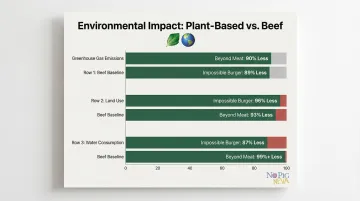
Peer-reviewed Life Cycle Assessments (LCAs) show where plant-based burgers pull ahead decisively: environmental impact.
Greenhouse gas emissions:
- Beyond Burger: 90% fewer emissions than beef
- Impossible Burger: 89% fewer emissions than beef
Land use:
- Impossible Burger: 96% less land required
- Beyond Burger: 93% less land required
Water consumption:
- Impossible Burger: 87% less water
- Beyond Burger: >99% lower impact on water scarcity
For consumers where environmental impact is the deciding factor, the data is clear: plant-based burgers reduce resource use across every major category measured.
Can Vegans Eat Plant-Based Burgers?
Not all plant-based burgers are vegan, and the term "plant-based" is not a regulated vegan standard.
Hidden Animal Ingredients
Some products marketed as "plant-based" contain animal-derived binders:
- MorningStar Farms Spicy Black Bean Burgers contain egg whites and calcium caseinate (milk)
- Trader Joe's Quinoa Cowboy Veggie Burgers contain egg white powder
Always read ingredient panels carefully.
The Animal Testing Conflict
Impossible Foods' soy leghemoglobin cannot qualify for Certified Vegan status because the company conducted 14- and 28-day rat toxicity studies in 2017 to secure FDA GRAS approval. The product itself contains no animal ingredients.
That distinction matters: this testing history still violates Vegan Action's certification standards, which prohibit any animal testing conducted after 2009.
Look for Certifications, Not Marketing
Third-party certifications tell you what marketing labels don't:
| Certification | What It Verifies | What It Doesn't Verify |
|---|---|---|
| Certified Vegan | No meat, dairy, eggs, or animal by-products; no animal testing post-2009 | GMO status, organic practices, nutritional quality |
| Non-GMO Project Verified | GMO avoidance through testing and supply chain verification | Vegan status, animal testing, animal-derived ingredients |
If you want to skip the label-checking entirely, NoPigNeva stocks only products that meet Certified Vegan standards — every item in their catalog has already cleared the bar.
How to Choose a Plant-Based Burger
Making the right choice starts with understanding your priorities.
Read Labels Strategically
Look for:
- Shorter ingredient lists with recognizable whole-food ingredients
- Sodium under 200mg per serving — the Mayo Clinic advises consumers to avoid packaged products exceeding 200mg
- Certifications: Certified Vegan, Non-GMO Project Verified, Gluten-Free (if needed)
Avoid:
- Products with 15+ ingredients you can't pronounce
- Sodium exceeding 20% of your daily value (460mg)
- Generic "plant-based" claims without vegan certification
Match Product to Purpose
| Your Goal | Best Choice |
|---|---|
| Nutrition first | Lentil, bean, or chickpea-based patties — whole-food options with natural fiber, protein, and micronutrients, minimal sodium, and no synthetic binders |
| Transitioning from meat | Pea or soy protein-based burgers — familiar textures and flavors that make the shift away from beef easier |
| Strict vegan ethics | Products with a Certified Vegan logo; avoid anything with unlabeled "natural flavors" or ambiguous animal testing disclosures |
Source from Trusted Retailers
Specialty vegan retailers like NoPigNeva carry curated ranges of 100% vegan, Non-GMO plant-based products, including burger options. Orders over $99.99 ship free nationwide, with no membership required to shop — though a membership program is available for shoppers who want an ongoing 10% discount.
Frequently Asked Questions
What are plant-based burgers made of?
Plant-based burgers are made primarily from plant-derived proteins like pea protein, soy, lentils, or mushrooms, combined with fats such as coconut oil, binders like methylcellulose or tapioca starch, and flavor enhancers like heme iron and nutritional yeast to mimic the taste of beef.
Are plant-based burgers really healthy?
While they offer benefits like fiber and zero cholesterol, many are ultra-processed with high sodium content (310–370mg vs. 75mg in beef). Treat them as an occasional option, not a daily staple. Whole plant foods like lentils and beans remain nutritionally superior.
What is the difference between a veggie burger and a plant-based burger?
Veggie burgers are any meatless patties made from vegetables, grains, or legumes without necessarily mimicking meat and are typically minimally processed. Plant-based burgers are specifically engineered to replicate beef's taste and texture, typically with 15–20+ ingredients and a heavier processing footprint.
Can vegans eat plant-based burgers?
Some plant-based burgers contain eggs, dairy, or ingredients with an animal-testing history, such as Impossible's heme. Vegans should look for Certified Vegan labeling to confirm products are free of animal derivatives and animal testing.
Are plant-based burgers healthier than beef burgers?
Plant-based burgers generally have less saturated fat and no cholesterol, but they can carry 4–5x more sodium and a heavier processing load. A lean beef patty may actually be less processed than some plant-based options, so comparing labels directly is the most reliable approach.