Introduction
Can vegan pork products — made entirely from plants — be considered halal? Pork is forbidden in Islam, but plant-based alternatives contain no animal ingredients whatsoever. The answer still isn't simple.
Islamic naming conventions, certification standards, ingredient scrutiny, and ongoing scholarly debate all shape whether a product qualifies — well beyond confirming "it's all plants."
Halal compliance isn't solely about ingredients. It also covers how products are presented, named, and marketed. A plant-based product might contain nothing haram in substance, yet still face scrutiny under Islamic dietary law due to its branding and sensory profile.
This article breaks down exactly where the lines are drawn — and what Muslim consumers should look for when evaluating vegan pork alternatives.
TLDR
- Vegan pork uses only plant-derived ingredients like soy, wheat gluten, and pea protein
- Plant-based meat is halal when all ingredients are permissible and nothing harmful is included
- Products labeled as "pork" cannot receive halal certification due to naming conventions
- Ingredient compliance and halal certification eligibility are two separate issues — both covered below
What Is Vegan Pork Actually Made Of?
Vegan pork products rely on specific plant proteins and oils engineered to mimic conventional pork's texture, flavor, and appearance.
Primary ingredients include:
- Textured soy protein or wheat gluten for a chewy, fibrous texture
- Pea or potato protein for structural integrity
- Coconut or sunflower oil to replicate pork's rich fat content
- Flavor compounds designed to replicate pork's distinct flavor
The Biotech Component: Soy Leghemoglobin
Brands like Impossible Foods use soy leghemoglobin (heme) to replicate pork's color, flavor, and aroma. This biotech ingredient is produced through fermentation using genetically modified yeast, which raises specific halal scrutiny questions.
The FDA approved soy leghemoglobin as Generally Recognized as Safe (GRAS) under GRN 000737 for use up to 0.8% in meat analogue products. However, halal certification requires verification of the fermentation process and growth media to ensure no animal derivatives or alcohol are used.
Hidden Ingredients That Complicate Halal Status
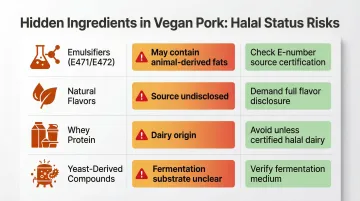
Beyond the main proteins and oils, several secondary ingredients can quietly determine whether a product clears halal standards. Each one requires its own scrutiny.
| Ingredient | Halal Risk | What to Look For |
|---|---|---|
| Emulsifiers (E471, E472) | Can derive from pork fat or non-zabiha beef | "Vegetable" source labeling or third-party halal certification |
| Natural Flavors | May contain meat extracts, dairy proteins, or animal enzymes | Full ingredient disclosure from manufacturer |
| Whey Protein | Coagulant may use animal enzymes — LPPOM MUI flags this as "very doubtful" | Confirm coagulant source directly with manufacturer or a halal certifier |
| Yeast-Derived Compounds | Processing may use alcohol as a carrier | Verify baker's yeast extract and similar ingredients individually |
What Makes Food Halal? The Core Islamic Dietary Principles
Islamic dietary law begins with a foundational principle: all foods are permissible (halal) by default unless explicitly prohibited by the Quran or authenticated Hadith.
The Default Permissibility of Plants
The legal maxim al-asl fi al-at'imah al-hill (halal is the original state of all foods) establishes that grains, fruits, flowers, and all plant-derived foods are halal — provided they are not toxic or intoxicating. Ibn Hazm's classical work Maraatib al-Ijmaa confirms scholarly consensus on this principle.
The Two Categories of Prohibition
Islamic dietary law identifies two main categories of prohibited substances:
Intrinsically haram substances include:
- Pig flesh (swine meat)
- Blood
- Alcohol and intoxicants
- Animals not slaughtered according to Islamic rites
The Quran explicitly forbids swine across multiple verses, including Surah Al-Baqarah 2:173: "He has only forbidden you to eat carrion, blood, swine, and what is slaughtered in the name of any other than Allah."
Foods that cause harm are also prohibited:
- Toxic or poisonous foods
- Substances that cause harm to health
- Ingredients that impair judgment
Reality vs. Nomenclature in Islamic Law
Ibn al-Qayyim al-Jawziyyah established an important principle in I'lam al-Muwaqqi'in: "What matters is the reality of things, and the ruling is to be based on that... Allah does not look at their outward forms and what people may call them; rather He looks at their reality and their essence."
Under this principle, plant-based pork qualifies as halal — its actual substance is plant matter, not pig flesh. That said, not all scholars stop there.
Sadd al-Zarai': Blocking the Means to Harm
Islamic jurisprudence also applies a counterbalancing principle: Sadd al-Zarai' (blocking the means), recognized prominently in Maliki and Hanbali schools. It prohibits even lawful actions if they create pathways to forbidden outcomes.
Applied to vegan pork, the concern has two parts:
- Consuming products that look, smell, and taste like pork could normalize association with a clearly prohibited food
- Familiarity with pork-like products increases the risk of accidentally consuming real pork
The Hadith "Actions are but by intentions" (Sahih al-Bukhari 1) reinforces this view — consuming plant-based pork with the intention or belief of eating pork carries its own prohibition, regardless of the actual ingredients.
Can Vegan Pork Be Halal? The Ingredient vs. Naming Problem
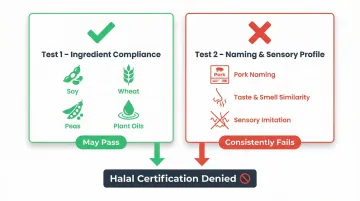
Islamic scholars and certification bodies apply a two-part test when evaluating vegan pork products.
The Two-Part Halal Assessment
Test 1: Are all ingredients halal? Plant-based pork can pass this test if all ingredients derive from permissible plant sources and contain no harmful or intoxicating substances.
Test 2: Does the name, appearance, or sensory profile create confusion or imitate a clearly haram product? Vegan pork products consistently fail on this second test — the naming and sensory imitation problem is what prevents halal certification, not the ingredient list.
The Scholarly Consensus
Most Islamic jurists and certification bodies — including MUIS (Singapore), MUI (Indonesia), ISA (USA), and JAKIM (Malaysia) — agree on two critical points:
- A product made entirely from halal plant ingredients is permissible in substance
- Naming or marketing it as "pork" makes it impermissible to certify — and many scholars advise Muslims to avoid it regardless of the ingredient source
The "Imitation of Haram" Argument
Scholars apply qiyas (analogical reasoning) to the imitation issue. Just as drinking plain water from an alcohol bottle while imitating a drunk person is considered haram by classical scholars like Al-Ghazali and Al-Bahuti, consuming plant-based products designed to perfectly mimic pork carries similar prohibition.
The reasoning centers on intent and presentation: a product engineered to replicate something forbidden — not just in substance but in every sensory aspect — violates Islamic principles even if the base materials are permissible.
The Consumer Safety Argument
In February 2020, MUIS (Singapore) officially advised Muslims against consuming Impossible Pork, stating:
"Authorities must also consider undesirable social consequences. In this case, it may cause confusion for the Muslim public from the use of the name of a clearly prohibited food item under Muslim law."
Certification bodies cite a real-world risk: if Muslims become accustomed to consuming products that replicate pork's exact taste, smell, and appearance, the likelihood of accidentally consuming genuine pork (or haram products) increases meaningfully.
What About Lab-Grown Pork?
Cultivated (lab-grown) pork represents a separate category entirely. Unlike plant-based pork, it is produced by culturing actual pig stem cells in a bioreactor.
Because lab-grown pork originates from pig cells, it sits in an entirely different legal category under Islamic dietary law. MUIS issued guidance in February 2024 stating that cultivated meat is halal only if the source cells come from halal animals. Since lab-grown pork derives from swine cells, it remains prohibited under Islamic dietary law regardless of how it is produced.
Why Halal Certification Bodies Won't Certify "Pork" Products
International halal certification agencies consistently reject products with "pork" in the name, even when ingredients are 100% plant-based.
ISA (Islamic Services of America) Position
ISA Vice President Timothy Hyatt stated clearly: "We would not approve a product with the name using the word 'pork,' adding that rejection of the word is an international standard among the world's halal certification agencies."
JAKIM Malaysia's Naming Rules
Malaysia's Manual Prosedur Pensijilan Halal Malaysia (MPPHM) and MS 1500:2019 standard explicitly state that halal food cannot be named or synonymously named after non-halal products such as ham, bak kut teh, bacon, beer, rum, and hotdog.
This isn't abstract policy — brands operating in Malaysia have had to rename established products to retain halal certification:
| Brand | Year | Required Change |
|---|---|---|
| Auntie Anne's | 2016 | "Pretzel Dog" → "Pretzel Sausage" |
| A&W | 2014 | "Root Beer" → "RB" and "Coney Dog" → "Chicken/Beef Coney" |
MUI Indonesia's Four-Point Fatwa Standard
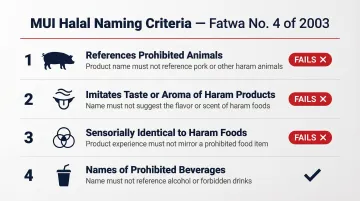
MUI's Fatwa No. 4 of 2003 establishes strict naming criteria. Products cannot receive halal certification if they:
- Use names referencing prohibited animals (especially pork or khamr/alcohol)
- Use mixed ingredients creating the taste or aroma of haram products
- Are sensory-identical to haram foods
- Use names of prohibited drinks
Vegan pork products violate at least points one, two, and three.
The fatwa is further reinforced by LPPOM MUI Decree SK46, which extends the rule to derivatives — roast pork, beef bacon, hot dogs — regardless of ingredients. The sensory profile of the product itself must not smell or taste like a haram food.
Ingredient-Level Concerns Beyond Naming
Some pork-flavored vegan products use sub-ingredients whose halal status is genuinely unclear:
- Emulsifiers derived from ambiguous sources (plant vs. animal origin not always disclosed)
- Flavor compounds that may include trace alcohol as a carrier solvent
- Processing aids that don't appear on the label but affect the final product
- Alcohol-based carriers used to deliver concentrated flavor extracts
For a Muslim consumer trying to make a compliant choice, this means the label alone isn't enough — the ingredient supply chain matters too. Even a product with no pork-derived components can fail halal standards if its flavor system uses non-compliant processing methods.
Looking for Halal-Friendly Plant-Based Meat? Here's What to Know
Plant-based meat alternatives not labeled as pork — burgers, sausages, chicken strips, and seafood alternatives — are generally considered halal, provided they meet a few specific requirements. The checklist below covers what to look for before buying.
What to Look For
Halal Certification Marks:
- IFANCA (Islamic Food and Nutrition Council of America)
- ISA (Islamic Services of America)
- Equivalent internationally recognized bodies
Ingredient Verification:
- Lists free of alcohol-derived carriers
- No ambiguous animal-sourced additives
- Clear sourcing for emulsifiers (E471/E472)
- Transparent "natural flavors" with halal verification
Naming Standards:
- Avoid any product whose name, branding, or flavor explicitly mimics pork
- Look for generic terms: plant-based burgers, vegan sausages, meat-free strips
Halal-Certified Plant-Based Brands
| Brand | Certified Products | Certifier |
|---|---|---|
| Impossible Foods | Impossible Beef, Impossible Sausage Links, Impossible Ground Sausage | IFANCA |
| Beyond Meat | Beyond Burger, Beyond Beef, Beyond Sausage, Beyond Chicken | ISA (valid through Dec 2026) |
Worth noting: Impossible Pork is not halal certified, even though other products in the Impossible lineup are. Always check the specific product, not just the brand.
NoPigNeva's Halal-Conscious Options
NoPigNeva stocks 100% vegan plant-based meat alternatives, including plant-based chicken, vegan seafood, and meat-free burgers and sausages — all free from animal-derived ingredients. Some products carry Kosher certification, which confirms they're pig-free, though Kosher and halal are separate standards and Kosher alone does not satisfy halal requirements.
If halal certification matters to you, check the product label or manufacturer's website directly — NoPigNeva's product pages include ingredient details to help you verify.
Frequently Asked Questions
Is plant-based meat halal in Islam?
Plant-based meat made from permissible plant ingredients (soy, wheat, peas) is generally considered halal by Islamic scholars, as all plants are halal by default. However, products must contain no haram additives, alcohol-based ingredients, or harmful substances.
Can vegan pork be halal?
While the ingredients of vegan pork may themselves be halal, the product cannot receive halal certification due to its name and pork-mimicking sensory profile. Most halal certification bodies and Islamic scholars advise Muslims to avoid it.
Is it haram to eat lab grown pork?
Lab-grown (cultivated) pork, derived from actual pig cells, is treated very differently from plant-based pork under Islamic law. It is widely considered haram because it originates from a prohibited animal, regardless of production method.
What is vegan pork made of?
Vegan pork typically combines several key ingredients:
- Textured soy or wheat protein for a meat-like chew
- Pea or potato protein for structure
- Coconut or sunflower oil for fat content
- Flavor compounds or heme (soy leghemoglobin) to mimic pork's taste and aroma
Why won't halal certification agencies certify vegan pork products?
Major bodies like ISA, JAKIM, and MUI hold that products referencing haram items by name (especially pork) cannot be certified halal. Certifying such products risks confusing consumers and blurring the line with a clearly prohibited food.
Are there plant-based meat alternatives that are halal-friendly?
Yes, many plant-based meat products (burgers, strips, sausages not labeled as pork) carry legitimate halal certification and are widely considered permissible. Check for recognized halal certification marks and review ingredient lists thoroughly before purchasing.